Investment Teaser
29,90 €Anonymous short profile for the first approach to potential buyers — discreet, precise, intriguing.
Buy individuallySix ready-to-use sample templates for a professional company sale.
Each template is also available individually — matching your current phase in the sale process.
Anonymous short profile for the first approach to potential buyers — discreet, precise, intriguing.
Buy individually
A reviewed sample NDA for handing over sensitive information to potential buyers.
Buy individually
A structured one-page profile with all the key figures and cornerstones of your company.
Buy individually
A full sale document for qualified outreach — market, business model, financials, prospects.
Buy individually
Sample letter of intent as a bridge from first conversations to structured contract negotiations.
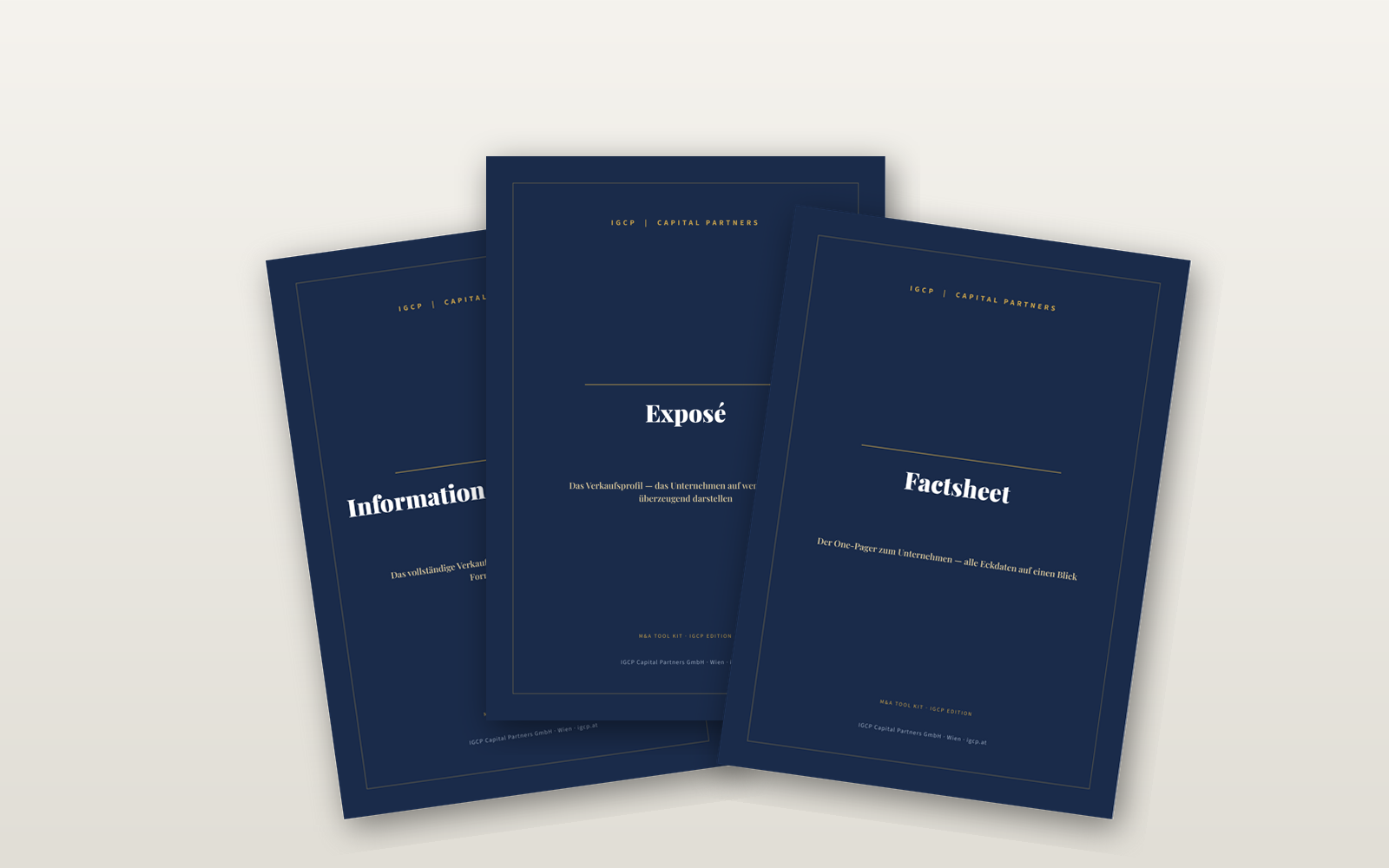
Buy individuallyA first impression from three of the six documents.
A company sale runs through a fixed chain of documents. Each one has its own purpose and its own moment — mixing them up costs you either confidentiality or prospects. The overview below maps the six templates onto the process.
The teaser is the first document a potential buyer sees, and the only one that goes out before the non-disclosure agreement is signed. It runs to one or two pages and stays fully anonymised: sector, rough region, business model, revenue magnitude, EBITDA range, headcount and the reason for the transaction. The most common mistake is over-precision — so much detail that anyone who knows the sector identifies the company in two minutes. The second most common is the opposite: phrasing so vague that no investor sees a reason to sign an NDA for it. Between those two failures lies the narrow corridor a good teaser hits: concrete enough for an in-principle investment decision, abstract enough for full discretion.
Only with a signed non-disclosure agreement does an anonymous contact become a participant in the process. Three points decide its practical value. First, the term: it has to reach beyond the end of the process, two to five years after abort or closing is standard. Second, the non-solicitation clause — a prospective buyer gains insight into your organisational structure and key people and must not use that insight for recruiting. Third, the clarification that it is not only the documents handed over that are confidential, but the intention to sell itself. Exactly that third point is regularly forgotten, and exactly it does the most damage when missing: a rumour about an upcoming sale unsettles employees, customers and suppliers at the same time.
The factsheet follows immediately after the signed NDA and names the company for the first time. It compresses onto a single page what an investor needs for a preliminary decision: key figures for the last three financial years, shareholder structure, headcount, customer and revenue clusters in anonymised form, and the intended transaction structure. Its purpose is speed. An investor reviewing twenty acquisition opportunities a month decides on this basis within five minutes whether to read on. Everything explanatory therefore belongs in the exposé and everything numerical on the factsheet — not the other way round.
At eight to fifteen pages, the exposé sits between the factsheet and the information memorandum. It answers the question of why this company earns money and why it will keep doing so without its current owner. It covers depth of value creation, market position and competitive environment, customer structure including dependencies, organisation and management level, and the degree of owner independence. For transactions roughly below five million euros in enterprise value, a properly worked exposé replaces the information memorandum entirely — the effort of a full IM bears no relation to the benefit at that size.
Depending on complexity the information memorandum runs to thirty or sixty pages and is the document on which a buyer bases the indicative offer. Two rules are not negotiable. First: every figure in the IM must later be verifiable from the data room — a discrepancy that surfaces during due diligence costs trust, and therefore purchase price. Second: known weaknesses belong in it. A buyer who discovers a risk himself during due diligence discounts the price; a buyer who read it in the IM has already priced it in. Customer concentration risk, expiring contracts, unresolved succession questions at the second management level: name them, put them in context, show what you are doing about them.
The letter of intent records what both sides agreed before due diligence: purchase price or price range including the valuation logic, share deal or asset deal, timetable, exclusivity and walk-away conditions. It is largely non-binding — with three exceptions that regularly are binding: confidentiality, exclusivity and cost allocation. Exclusivity is where sellers most often give away negotiating position. Twelve weeks of exclusivity without defined milestones means the only remaining counterparty has three months to renegotiate the price while every alternative has been turned away. Exclusivity belongs time-limited and tied to progress.
Not yet at the document stage, but at the decision: Selling a company · Selling a GmbH · Company valuation
Six ready-to-use sample templates for a professional company sale: Investment Teaser, NDA, Factsheet (one-pager), Exposé, Information Memorandum and Letter of Intent — each as a digital PDF with completion guidance.
Yes. Each of the six templates is available individually. At €149 incl. VAT the complete package is around 25% cheaper than buying all six documents individually (€199.40).
No. The legal samples (in particular NDA and LOI) are non-binding sample text building blocks grown out of more than 15 years of transaction practice. They do not replace legal advice in a specific case.
You receive the templates by email as digital PDFs immediately after successful payment — together with the invoice. No account, no waiting.
Note: The legal samples (NDA, LOI) are non-binding text building blocks and do not replace legal advice in a specific case.