M&A Data Room Manager
The ready-to-use structure for your virtual data room — prepare, manage buyer questions, review the tech.
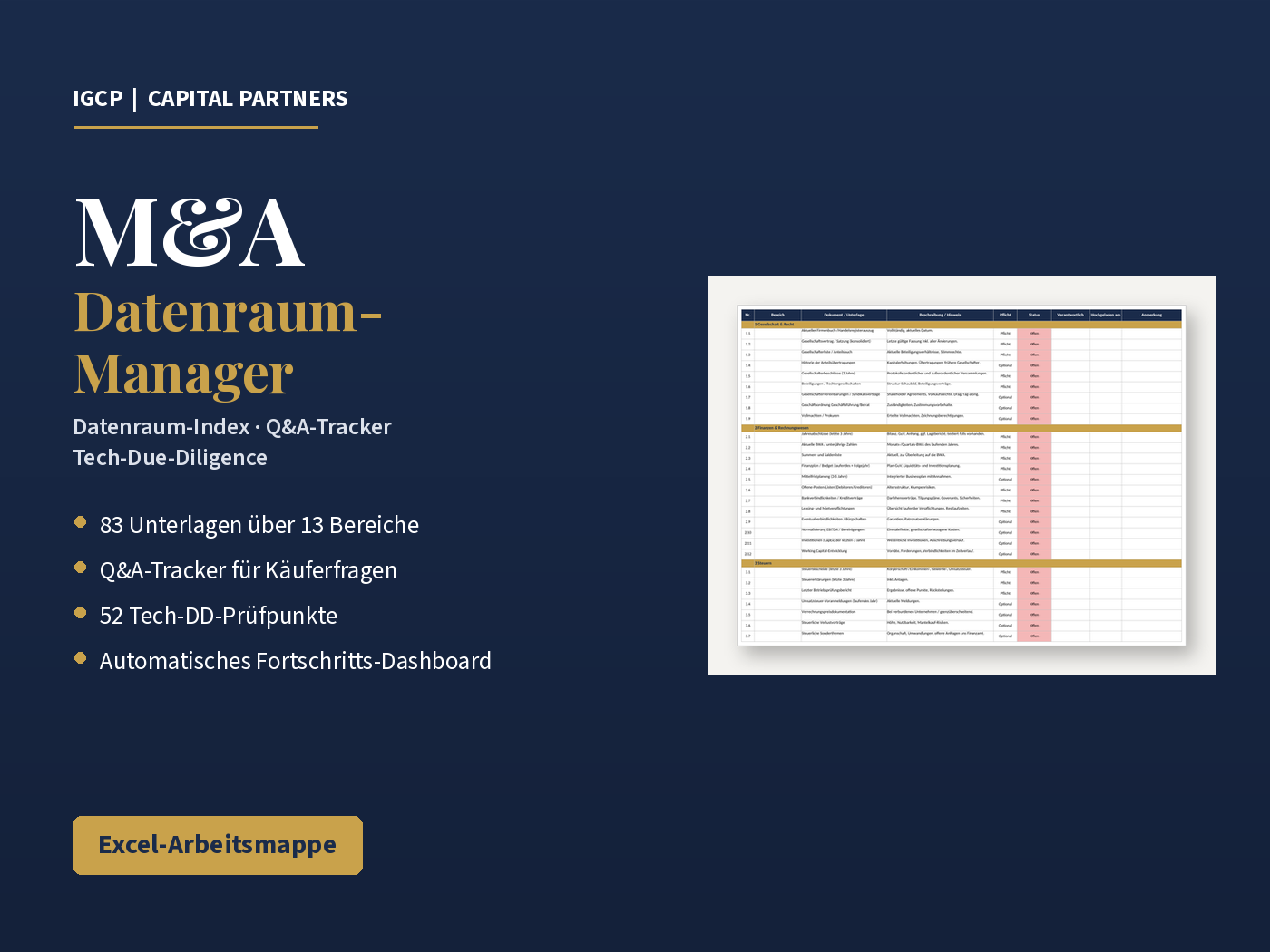
M&A Data Room Manager
The ready-to-use structure for your virtual data room — prepare, manage buyer questions, review the tech.
- Ready data room index: 83 documents across 13 areas, status per document via dropdown
- Q&A tracker: every buyer question with priority, answer and reference to the data room document
- Tech due diligence: 52 review points on code quality, licences and open-source risks
- Automated dashboard for completion rate and answer rate
Who it is for.
The M&A Data Room Manager is built for owners preparing a sale, succession or investor entry, as well as for buyers and advisors — tax advisors, lawyers, M&A boutiques and search funds — who need to review a target company in a structured way.
The tech due diligence checklist is particularly useful for software and tech companies whose value lies in code, architecture and licences.
What you get.
An Excel workbook with five sheets — instructions, an automated overview dashboard, a data room index (83 documents across 13 areas from corporate law to ESG), a Q&A tracker for buyer questions and a tech due diligence checklist with 52 review points on code quality, open-source licences, security and dependencies.
Status dropdowns, traffic-light logic and formulas are pre-configured. You add content; the dashboard updates automatically.
The virtual Data Room in the M&A process
The Data Room is the infrastructure of the sale process. It determines how fast buyers can work, how much confidentiality is preserved and how many follow-up questions you have to answer. Six points from practice that make the difference between an orderly and a laborious process.
The index comes before the documents
The most common mistake is to start with uploading. The correct order is the reverse: first define the structure by review areas, number every folder, create a line in the index for every expected document — with status, owner and deadline. Only then do you fill it. The index is at the same time your project plan: it shows at any moment which documents are missing, who is working on them and whether you will be ready for release in a week. Without that list nobody keeps an overview, and the process is driven by reminder emails.
Staged access rights instead of all-or-nothing
Not every prospect needs the same depth. A three-stage release has proven itself: in the first round bidders see the levels that suffice for an indicative offer — finance, market, structure. Once offers are in, the second level is opened for the remaining bidders. Genuinely sensitive content — full customer lists with names and terms, salary details, source code, formulations, price calculations — stays locked until exclusivity, or is shown only redacted or in a clean-room review. Otherwise a competitor who signs and never buys has been handed a complete market analysis.
The Q&A process has to be channelled
Every process brings between fifty and several hundred buyer questions. If these run by email to different people, contradictory answers arise — and contradictions become warranty issues in the purchase agreement. Therefore run a central Q&A tracker: sequential number, date, questioner, review area, responsible answerer, approval status, answer date. Every answer goes out through one point. In the end the tracker is at the same time the documentation of what you disclosed — and therefore liability-relevant.
Activity logs reveal purchase intent
Every professional Data Room logs who opened which document, when and for how long. This data is an underrated negotiating instrument. A bidder whose team works systematically through all levels over two weeks is serious. One who does not return after the first login is effectively out — regardless of what he says on the phone. Unusual patterns also stand out: mass downloads in a short period, or isolated interest solely in customer lists, are a warning signal.
Tech Due Diligence as a review area of its own
For software, IT and technology-related companies the classic areas are not enough. The buyer additionally reviews architecture and scalability, technical debt, test and release processes, open-source licences and their copyleft effect on his own product, dependence on individual developers, security vulnerabilities and the state of the documentation. These questions come reliably — and anyone who only answers them when they are asked loses weeks. A prepared tech area with an architecture overview, licence inventory and roadmap takes away the buyer’s argument for applying a risk discount.
Data protection and redaction are mandatory, not optional
Personal data must not go into the Data Room unfiltered. Employment contracts, salary lists and personnel files belong there anonymised or pseudonymised — the usual approach is a listing by function, start date, contract type and salary band without names. Customer contracts too regularly contain clauses prohibiting disclosure to third parties without consent. Working sloppily here risks not only the data protection breach but, in the worst case, hands the buyer a compliance finding that travels straight into the purchase agreement.
The right next steps: Due diligence checklist · Selling a company · M&A Tool Kit
Frequently asked questions.
In what format do I receive the Data Room Manager?
As an Excel workbook (.xlsx). The download starts immediately after payment; we also send you the workbook and invoice by email. The workbook works with Microsoft Excel, LibreOffice Calc and Google Sheets.
Is the workbook useful for sellers and for buyers?
Yes. Sellers use it to prepare their data room in a structured way; buyers and advisors use the same structure to review the target. The Q&A tracker keeps the question-and-answer process transparent for both sides.
Does the workbook replace professional due diligence or advisory?
No. The workbook brings structure, completeness and transparency upfront. It does not replace a guided commercial, financial, tax and legal review under an engagement.
Looking for individual support? See our services at Sell a company and Buy a company.